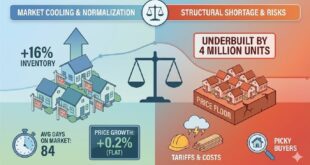
The 2025 housing market shifted toward normalization as inventory climb 16.4% and homes remained on the market for an average of 84 days. Despite a structural shortage of 4 million units keeping prices stable, demand has become increasingly selective across a "patchwork" of local markets. Macroeconomic factors, including Federal Reserve interest rate policy and Trump administration tariffs, are introducing new volatility into construction costs and supply chains. With 39% of listings now seeing price cuts, the market is finding a new equilibrium. This analysis explores why today’s softening differs from past cycles and what the new policy risks mean for buyers in 2026.
Read More »The Changing Correlation Between the U.S. Dollar and the Stock Market
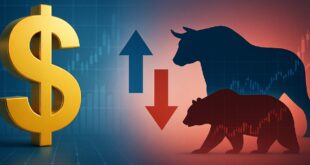
The historical relationship between the U.S. dollar and the U.S. stock market has shifted from a weak positive correlation to a stronger inverse pattern. While global capital flows once linked a stronger dollar to rising U.S. equities, recent years show the opposite movement as risk-on and risk-off dynamics dominate. During risk-off periods, investors seek safety in the dollar, pushing it higher as equities fall. Conversely, a weaker dollar often aligns with a stronger global risk appetite. This article examines this correlation and the implications for investors.
Read More »Investors Eye a Soft Landing After Fed’s Big Rate Cut, But Caution Remains
The Federal Reserve's recent 50-basis point rate cut has bolstered optimism for a "soft landing," pushing the Dow, S&P 500, and NASDAQ to new highs. While the move has alleviated uncertainty, investors remain wary of potential economic risks, including a slowing labor market and lingering inflation concerns. Despite the positive market reaction, some experts warn that market volatility could resurface if inflation picks up or the labor market weakens further. With the Fed expected to announce more rate cuts later this year, all eyes are on the November meeting for clues on future economic policy.
Read More »Gold Rises in August Amid Rate Cut Speculation and Election Concerns
The World Gold Council published its monthly Gold Market Commentary for August this week. Gold surged by 3.6% in August, reaching $2,513 per ounce, driven by a weaker U.S. dollar and lower Treasury yields. Investors are positioning for potential rate cuts by the U.S. Federal Reserve and the uncertainties surrounding the U.S. election. Demand also saw a boost from a reduction in gold import duties in India, contributing to strong buying interest. Meanwhile, gold-backed ETFs extended their four-month inflow streak. As traders brace for a volatile second half of 2024, gold remains a key hedge against risk, with global economic uncertainties and U.S. political developments fueling the demand.
Read More »Mining Companies that Could Benefit Significantly from Gold’s 21% YTD Rise
Since the start of the year, gold prices have surged over 21%, reaching US$2,508 per ounce. Key drivers include increased central bank purchases, geopolitical tensions, expectations of U.S. interest rate cuts, and persistent inflation. These factors have created a favourable environment for gold, benefiting mining companies with substantial gold resources. This article examines the leading gold producers—Newmont, Barrick, AngloGold Ashanti, Agnico Eagle, Gold Fields, and Kinross Gold—highlighting their key assets and strategic positioning in this bullish market.
Read More »Five-Year Performance Review of Gold and Gold-Related ETFs Amid Market Volatility
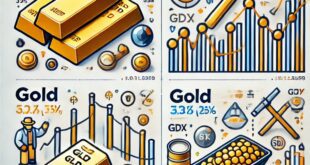
Over the past five years, gold and gold-related ETFs have experienced significant fluctuations due to economic events, changing interest rates, and shifting market sentiment. This article reviews the performance of gold, the SPDR Gold Trust (GLD), VanEck Gold Miners ETF (GDX), and VanEck Junior Gold Miners ETF (GDXJ). Gold rose by over 60%, while GLD closely mirrored this increase. In contrast, GDX and GDXJ significantly underperformed, with GDX up only 30% and GDXJ up just 12%. This analysis highlights the varying risks and returns associated with different gold-related investments.
Read More »Rapid Rise In Interest Rates Will Collapse U.S. Financial System – Here’s Why (+12K Views)
When interest rates go down, that spurs economic activity, and that is good for stock prices, so when interest rates start going up rapidly, that is not a good thing for the stock market at all.
Read More »The 5 Phases of the Economic Cycle: Where Are We Now? (+4K Views)
What phase are we in today? We are in the middle to late stages of Phase IV and Phase V — monetary reform to inflate away mountains of debt — is right around the corner! Words: 1864
Read More »Record $30,000,000,000,000 National Debt Signals Currency Crisis Ahead!
Total public debt outstanding has surpassed $30,000,000,000,000 which serves as a dire warning for American workers, investors, and retirees
Read More »Massive Debt = Dollar Collapse = High Inflation = Likely Depression (+4K Views)
The value of a currency is determined by a number of variables. In this article, I will focus on the dynamics of demand, supply, current account deficits, and aggregate government debt.
Read More »
munKNEE.com Your Key to Making Money