Friday , 13 March 2026

Economy

America’s Inability to Increase Revenues Via Higher Personal Taxes Could Cause the USD to Crash

2026-02-15 MunKnee - America’s Inability to Increase Revenues

Do higher marginal tax rates materially increase federal revenue? Behavioral responses among high-income taxpayers, the impact of enforcement capacity on compliance, and other implications of restoring pre-2017 tax rates all affect the results. The discussion highlights how income adjustments and structural deficits may limit the effectiveness of rate increases. With annual federal deficits exceeding one trillion dollars in recent years, constrained revenue elasticity, combined with elevated spending, could affect investor confidence and long-term demand for US dollars.

Read More »

Japan’s “Weak Decades” is a Warning for the Global Class of 2026

Munknee-The Japanification Trap

Japan’s post-1989 experience provides a long-running case study on the limits of monetary and fiscal stimulus. After the collapse of a combined equity and property bubble, Japan relied on sustained deficits, near-zero interest rates, and repeated stimulus to stabilize growth. While markets eventually recovered in nominal terms, the process took decades and coincided with a sharp rise in government debt. In 2026, rising bond yields and higher debt servicing costs are testing the durability of this approach. The Japanese experience offers a relevant framework for assessing similar policy paths now being followed globally.

Read More »

How AI Is Creating a Recovery Without Workers

As of early 2026, economic data points to steady GDP growth, yet labor market conditions tell a different story. Investment in artificial intelligence is supporting output and corporate margins, while hiring remains subdued and worker mobility constrained. Historical recoveries show employment often lags growth, but current conditions suggest a deeper structural shift. Automation, policy constraints, and uneven access to technology are reshaping how growth is generated and who benefits from it. The result is an expansion that favors capital over labor, raising concerns about income durability, consumer demand, and long-term economic stability if workforce participation continues to weaken.

Read More »

Why $4,500 Gold Is Only the Beginning

2026-01-08 Gold and the US Dollar

Gold’s rise to over $4,500/oz in 2025 reflects deep structural imbalances in global currency management. As inflation erodes purchasing power, gold’s share of global financial assets has begun to recover from historic lows. Central banks, particularly in emerging markets, are diversifying away from the U.S. dollar and increasing gold holdings. The U.S. government’s long-standing influence through major financial institutions is weakening as AI-driven trading and geopolitical shifts reshape the market. The reassertion of the physical gold market marks a turning point for investors evaluating the future of monetary stability.

Read More »

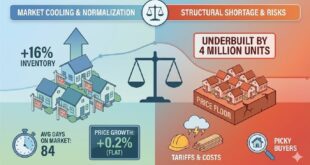
The Great Housing Market Normalization of 2025

2025-12-30 The US Housing Market

The 2025 housing market shifted toward normalization as inventory climb 16.4% and homes remained on the market for an average of 84 days. Despite a structural shortage of 4 million units keeping prices stable, demand has become increasingly selective across a "patchwork" of local markets. Macroeconomic factors, including Federal Reserve interest rate policy and Trump administration tariffs, are introducing new volatility into construction costs and supply chains. With 39% of listings now seeing price cuts, the market is finding a new equilibrium. This analysis explores why today’s softening differs from past cycles and what the new policy risks mean for buyers in 2026.

Read More »

The U.S. Dollar: Too Much of a Good Thing?

The US Dollar - Too Big to Fail

Is the U.S. dollar, as the primary global reserve currency, under threat? While the dollar maintains its position through the petrodollar system and military backing, structural risks such as the $38.4 trillion national debt and the diversification of foreign reserves pose challenges. What could trigger a monetary shift? A gold revaluation? Debt defaults? Investors should consider the strategic importance of physical gold as a hedge against currency transitions and the long-term erosion of purchasing power.

Read More »

The Changing Correlation Between the U.S. Dollar and the Stock Market

Changing Correlation Between the U.S. Dollar and the Stock Market

The historical relationship between the U.S. dollar and the U.S. stock market has shifted from a weak positive correlation to a stronger inverse pattern. While global capital flows once linked a stronger dollar to rising U.S. equities, recent years show the opposite movement as risk-on and risk-off dynamics dominate. During risk-off periods, investors seek safety in the dollar, pushing it higher as equities fall. Conversely, a weaker dollar often aligns with a stronger global risk appetite. This article examines this correlation and the implications for investors.

Read More »

The Gold-Silver Ratio as an Indicator of Economic Conditions and Risk Appetites

2025-10-23 Notes from the Rabbit Hole - Gold Silver Ratio - 30-Year US Treasury

Gary Tanashian of Notes From the Rabbit Hole (NFTRH) analyzed the Gold-Silver Ratio (GSR) throughout 2024–2025 as an indicator of risk sentiment and economic liquidity. A rising GSR suggested market caution, stronger dollar performance, and silver underperformance, while a falling ratio reflected potential reflation trends and risk-on behavior. Tanashian emphasized that investors should combine GSR analysis with additional indicators such as the HUI gold miner index, U.S. dollar trends, and Treasury yields. He also introduced the 30-year Treasury yield “Continuum” to interpret whether GSR shifts represent lasting market signals or temporary reactions.

Read More »

U.S. Pension Funds Face Persistent Underfunding and Inflation Risks

pension piggy bank

Many U.S. pension funds remain underfunded, creating concerns about their ability to meet future obligations. Despite the trillion-dollar size of the U.S. retirement market, public pension plans face trillion-dollar funding gaps. Inflation and dollar devaluation continue to erode purchasing power, yet pension portfolios remain heavily weighted toward equities, bonds, and real estate. With commodities representing only a tiny percentage of total assets and gold and silver holdings minimal, the case for broader diversification and inflation protection remains relevant for both public and private pension managers seeking sustainable long-term returns.

Read More »

How to Maximize Investment Gains When Investing in Gold

Gold recently surpassed $3,500/oz, attracting investors looking for protection from economic uncertainty and global instability. With rising sovereign debt and reduced confidence in fiat currencies, analysts see potential for gold to reach $10,000 to $25,000 per ounce. Central bank accumulation, underinvestment in mining, and geopolitical risks add to the bullish case. Investment strategies include physical gold, mining stocks, and ETFs such as GDX and GDXJ. Companies like Barrick Gold, New Gold, and Lake Victoria Gold are noted for their positioning. The article outlines why gold may become a key investment theme heading into 2025.

Read More »