American households are facing a tough financial reality. Despite efforts to bring manufacturing back home, income inequality is widening as real wages fail to keep up with rising debt. While wealth continues to concentrate at the top, a huge segment of the population remains financially squeezed and dependent on federal support. Between the pressures of globalization and a thickening layer of regulation, job creation is hitting a wall. This divide isn't just a trend; it's a structural problem that makes our current economic path look increasingly unsustainable.
Read More »Why $4,500 Gold Is Only the Beginning
Gold’s rise to over $4,500/oz in 2025 reflects deep structural imbalances in global currency management. As inflation erodes purchasing power, gold’s share of global financial assets has begun to recover from historic lows. Central banks, particularly in emerging markets, are diversifying away from the U.S. dollar and increasing gold holdings. The U.S. government’s long-standing influence through major financial institutions is weakening as AI-driven trading and geopolitical shifts reshape the market. The reassertion of the physical gold market marks a turning point for investors evaluating the future of monetary stability.
Read More »The U.S. Dollar: Too Much of a Good Thing?
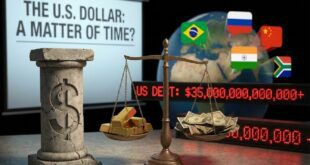
Is the U.S. dollar, as the primary global reserve currency, under threat? While the dollar maintains its position through the petrodollar system and military backing, structural risks such as the $38.4 trillion national debt and the diversification of foreign reserves pose challenges. What could trigger a monetary shift? A gold revaluation? Debt defaults? Investors should consider the strategic importance of physical gold as a hedge against currency transitions and the long-term erosion of purchasing power.
Read More »The Changing Correlation Between the U.S. Dollar and the Stock Market
The historical relationship between the U.S. dollar and the U.S. stock market has shifted from a weak positive correlation to a stronger inverse pattern. While global capital flows once linked a stronger dollar to rising U.S. equities, recent years show the opposite movement as risk-on and risk-off dynamics dominate. During risk-off periods, investors seek safety in the dollar, pushing it higher as equities fall. Conversely, a weaker dollar often aligns with a stronger global risk appetite. This article examines this correlation and the implications for investors.
Read More »The Gold-Silver Ratio as an Indicator of Economic Conditions and Risk Appetites
Gary Tanashian of Notes From the Rabbit Hole (NFTRH) analyzed the Gold-Silver Ratio (GSR) throughout 2024–2025 as an indicator of risk sentiment and economic liquidity. A rising GSR suggested market caution, stronger dollar performance, and silver underperformance, while a falling ratio reflected potential reflation trends and risk-on behavior. Tanashian emphasized that investors should combine GSR analysis with additional indicators such as the HUI gold miner index, U.S. dollar trends, and Treasury yields. He also introduced the 30-year Treasury yield “Continuum” to interpret whether GSR shifts represent lasting market signals or temporary reactions.
Read More »Technicals Suggest Gold Setting Sights Beyond $3,000 if Bull Cycle Continues
Gold’s long-term trend has been shaped by inflation, monetary policy, and global economic shifts. Since 2016, the metal has been in a renewed uptrend, surpassing its previous highs. Historical cycles show that when gold moves, it moves fast. With gold now above its inflation-adjusted highs of $2,700, a sustained breakout above $3,000 could signal the next phase of its rally. Technical levels suggest that once gold clears key resistance zones, $4,000 may be the next significant target. This article examines gold’s historical patterns and key price levels, offering insights into what may be ahead for the precious metal.
Read More »Dump Dollars and Buy Gold – Here’s Why
If you are holding U.S. dollars in a savings account, CD or money-market fund, you are slowly losing what you have saved or inherited and within a few short years you could lose the bulk of what is remaining. It is being done in such a way that most people don't notice. The hidden tax of inflation has been robbing you for quite some time and the pace and severity of this theft is increasing rapidly. If I sound alarmist, it is with intention.
Read More »Investors Eye a Soft Landing After Fed’s Big Rate Cut, But Caution Remains
The Federal Reserve's recent 50-basis point rate cut has bolstered optimism for a "soft landing," pushing the Dow, S&P 500, and NASDAQ to new highs. While the move has alleviated uncertainty, investors remain wary of potential economic risks, including a slowing labor market and lingering inflation concerns. Despite the positive market reaction, some experts warn that market volatility could resurface if inflation picks up or the labor market weakens further. With the Fed expected to announce more rate cuts later this year, all eyes are on the November meeting for clues on future economic policy.
Read More »Timeless: Gold & Silver Are A Pair of Aces for a Winning Hand!
“Every portfolio should have a 10% core holding of gold and silver as emergency money” was the simple and timeless message in Glen O. Kirsch conveyed 33 years ago in an article entitled: “What’s in Your Core Holdings?” and such a message is even more appropriate today given the unsettling fiscal, economic and investment environment. Words: 692
Read More »Gold Rises in August Amid Rate Cut Speculation and Election Concerns
The World Gold Council published its monthly Gold Market Commentary for August this week. Gold surged by 3.6% in August, reaching $2,513 per ounce, driven by a weaker U.S. dollar and lower Treasury yields. Investors are positioning for potential rate cuts by the U.S. Federal Reserve and the uncertainties surrounding the U.S. election. Demand also saw a boost from a reduction in gold import duties in India, contributing to strong buying interest. Meanwhile, gold-backed ETFs extended their four-month inflow streak. As traders brace for a volatile second half of 2024, gold remains a key hedge against risk, with global economic uncertainties and U.S. political developments fueling the demand.
Read More »
munKNEE.com Your Key to Making Money