munKNEE.com Your Key to Making Money
Gold is known all over the world as the “canary in the coal mine” of money. A gold price that reached all-time highs of over $4,500/oz last year is a wake-up call that national currencies are not managed well and their purchasing power is being drained by the ongoing inflationary pressures.
Intervention in the Gold Market by the U.S. Government
The U.S. government stands to lose the most if the market prefers gold to fiat currency since the U.S. dollar is the reserve currency in the world. That situation would undermine its monopoly privilege of issuing money.
To maintain this illusion, the U.S. government would need to step in; unfortunately, it is becoming less and less capable of doing so. As we witnessed in 2025, gold prevailed.
Over the years, the government had been letting the price of gold increase at a modest pace- approximately 15% per year. The “canary” began screaming in 2025 when gold shot up more than 60% in one year.
The controlled withdrawal became a rout in battlefield terms. Even at these record levels, gold is still thought to be structurally underpriced relative to the growth of the world debt and the recent reversion to aggressive Fed rate-cutting cycles.
Gold’s Share of the Money Supply
Gold made up about 40% of the money in the world until the end of the 19th century. By 1999, that percentage had narrowed down to approximately 1%.
Even today, with the record rally, the proportion of gold in the total global financial assets has only started to increase, up to about 2.8% percent by the end of 2025.
If gold went back to 10% of the global money supply, today’s gold price would still be a bargain. With the current global M2 money supply estimated at around $100 trillion, a 10% backing would actually imply a gold price higher than $10,000/oz.
The U.S. Government and the Gold Price
It was simple. They used to take advantage of Big Banks to make trades that advanced the government’s interests. These banks were the de facto gold cartel, which was implicitly supported by the U.S. government.
The cartel has, however, had its job multiplied by the fact that AI-based algorithmic models now enhance the trend-following behavior, which made the gold price explode above the historical resistance levels at a rate that the cartel could not keep down.
The Modern Predicament
The situation has changed. The crisis is currently geopolitical and systemic. Central banks, headed by Poland, China, and Brazil, are no longer mere value hunters but are diversifying out of the dollar aggressively to cushion themselves against sanctions and currency volatility.
Although the share of U.S. Treasuries in the central bank reserves still makes up 58% of global reserves, gold has overtaken U.S. Treasuries among several major emerging market central banks.
The physical supply is structurally challenged as the institutional ETFs demand and the sovereign nations’ demand increase. The central banks that borrowed gold in past decades cannot be repaid easily without driving the price to the level above $5000/oz, which most analysts are currently projecting by the end of 2026.
If the central banks called in their physical bars today, the “paper” gold market would likely collapse because the physical metal has been sold multiple times over.
Final Thoughts
For decades in the gold market, paper contracts and backroom leases maintained the illusion of U.S. dollar supremacy, but the physical market has finally reasserted itself. We are no longer debating whether the system will change, as we watched it happen in 2025.
As sovereign nations trade their U.S. dollars for the “certainty” of gold, investors are left with a decision: continue to have faith in the U.S. dollar or follow the lead of the world’s central banks.
If history is any guide, the canary isn’t just warning us about the air in the mine anymore, it’s telling us it’s time to get out of the mine.
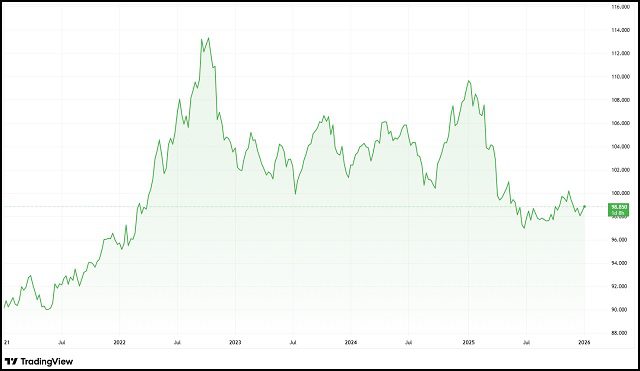
FIGURE 1: US Dollar Index (5-Year)