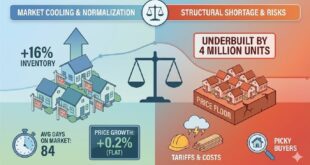
The 2025 housing market shifted toward normalization as inventory climb 16.4% and homes remained on the market for an average of 84 days. Despite a structural shortage of 4 million units keeping prices stable, demand has become increasingly selective across a "patchwork" of local markets. Macroeconomic factors, including Federal Reserve interest rate policy and Trump administration tariffs, are introducing new volatility into construction costs and supply chains. With 39% of listings now seeing price cuts, the market is finding a new equilibrium. This analysis explores why today’s softening differs from past cycles and what the new policy risks mean for buyers in 2026.
Read More »The U.S. Dollar: Too Much of a Good Thing?
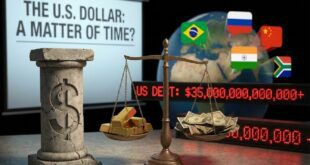
Is the U.S. dollar, as the primary global reserve currency, under threat? While the dollar maintains its position through the petrodollar system and military backing, structural risks such as the $38.4 trillion national debt and the diversification of foreign reserves pose challenges. What could trigger a monetary shift? A gold revaluation? Debt defaults? Investors should consider the strategic importance of physical gold as a hedge against currency transitions and the long-term erosion of purchasing power.
Read More »The Changing Correlation Between the U.S. Dollar and the Stock Market
The historical relationship between the U.S. dollar and the U.S. stock market has shifted from a weak positive correlation to a stronger inverse pattern. While global capital flows once linked a stronger dollar to rising U.S. equities, recent years show the opposite movement as risk-on and risk-off dynamics dominate. During risk-off periods, investors seek safety in the dollar, pushing it higher as equities fall. Conversely, a weaker dollar often aligns with a stronger global risk appetite. This article examines this correlation and the implications for investors.
Read More »U.S. Pension Funds Face Persistent Underfunding and Inflation Risks
Many U.S. pension funds remain underfunded, creating concerns about their ability to meet future obligations. Despite the trillion-dollar size of the U.S. retirement market, public pension plans face trillion-dollar funding gaps. Inflation and dollar devaluation continue to erode purchasing power, yet pension portfolios remain heavily weighted toward equities, bonds, and real estate. With commodities representing only a tiny percentage of total assets and gold and silver holdings minimal, the case for broader diversification and inflation protection remains relevant for both public and private pension managers seeking sustainable long-term returns.
Read More »Technicals Suggest Gold Setting Sights Beyond $3,000 if Bull Cycle Continues
Gold’s long-term trend has been shaped by inflation, monetary policy, and global economic shifts. Since 2016, the metal has been in a renewed uptrend, surpassing its previous highs. Historical cycles show that when gold moves, it moves fast. With gold now above its inflation-adjusted highs of $2,700, a sustained breakout above $3,000 could signal the next phase of its rally. Technical levels suggest that once gold clears key resistance zones, $4,000 may be the next significant target. This article examines gold’s historical patterns and key price levels, offering insights into what may be ahead for the precious metal.
Read More »What the Rising Dollar Price of Gold Really Means
A soaring gold price is a vote of "no confidence" in the central bank and the dollar [and]... reflect a growing restlessness with the increasing money supply, our budgetary and trade deficits, our unfunded liabilities, and the inability of Congress and the administration to reign in runaway spending. Words: 1911
Read More »Gold Rises in August Amid Rate Cut Speculation and Election Concerns
The World Gold Council published its monthly Gold Market Commentary for August this week. Gold surged by 3.6% in August, reaching $2,513 per ounce, driven by a weaker U.S. dollar and lower Treasury yields. Investors are positioning for potential rate cuts by the U.S. Federal Reserve and the uncertainties surrounding the U.S. election. Demand also saw a boost from a reduction in gold import duties in India, contributing to strong buying interest. Meanwhile, gold-backed ETFs extended their four-month inflow streak. As traders brace for a volatile second half of 2024, gold remains a key hedge against risk, with global economic uncertainties and U.S. political developments fueling the demand.
Read More »Five-Year Performance Review of Gold and Gold-Related ETFs Amid Market Volatility
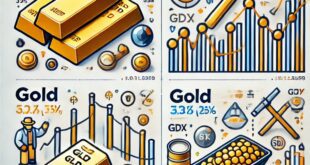
Over the past five years, gold and gold-related ETFs have experienced significant fluctuations due to economic events, changing interest rates, and shifting market sentiment. This article reviews the performance of gold, the SPDR Gold Trust (GLD), VanEck Gold Miners ETF (GDX), and VanEck Junior Gold Miners ETF (GDXJ). Gold rose by over 60%, while GLD closely mirrored this increase. In contrast, GDX and GDXJ significantly underperformed, with GDX up only 30% and GDXJ up just 12%. This analysis highlights the varying risks and returns associated with different gold-related investments.
Read More »Fekete: Gold is the Answer to Economic Woes (+3K Views)
What's an individual investor to do to make sure that his investments will not be completely wiped out in the coming financial Armageddon? Gold is the answer.
Read More »Beware: Official U.S. Government Price for Gold is Only $42.22/ozt. (+9K Views)
The United States has seen four different gold confiscations — the last of which was in 1933. Few people realize that when the freedom to own gold was restored in 1972, the President retained the power to require us to surrender our gold which he can do again any time (probably on a Friday) with the mere stroke of a pen. That means all confiscated gold could possibly be compensated at only $42.22 per 1oz. and not at the world market price. Don’t take this decision lightly. It was another blatant warning that the government may be contemplating grand larceny — AGAIN. Words: 1740
Read More »
munKNEE.com Your Key to Making Money