munKNEE.com Your Key to Making Money
Given universal awareness and belief that greenhouse gases are placing our world on the brink of imminent disaster, we should look at the origins of the climate change issue and who is doing what to fix it.
For many people, awareness and concern have emerged as if by stealth. Our children arrive home from school all wide-eyed and anxious about the imminent extinction of polar bears, melting polar ice caps, and glaciers. Frequently, too, we see programs on streaming services that portray what seems to be a world hell-bent on its own destruction and predicting an imminent environmental Armageddon.
United Nations Secretary-General António Guterres has consistently warned of “global boiling,” predicting the certain demise of most living things unless greenhouse gases are dramatically limited starting immediately.
It is clearly apparent that the vehicles of mass communication, especially the popular media, the entertainment industry, the public school systems, as well as society’s opinion leaders, have been working overtime to inform and alarm us to the calamities ahead if we fail to throttle back the creation of carbon dioxide and other greenhouse gases.
Where, When, and How did the Global Warming Issue Begin to Take Shape?
The climate change issue started with predictions of a coming Ice Age, but that theme was quickly abandoned in favour of the warming scenario.
The Earth’s apparent rapid warming gained traction first at a UN conference on environmental issues held in Switzerland in 1971. Canadian Maurice Strong served as Secretary-General of the 1972 Stockholm Conference on the Human Environment, the first major UN conference on environmental issues. This conference addressed broad environmental concerns rather than specifically climate change, which became a focus of international policy in later decades.
Funding for climate research was increasingly made available, papers written, and findings shared, culminating in the creation of the “Intergovernmental Panel on Climate Change” (IPCC) in 1988. It was this UN-sponsored entity that drove the warming issue thereafter, resulting in much greater public awareness, in part a consequence of another even larger conference held in Rio de Janeiro, Brazil, in 1992.
Conferences Led to More Conferences
It seems that the scale of the Rio conference and those which followed (which involved many thousands of attendees representing most of the world’s nations, international Non-Governmental Organizations (NGO’s) and other technical and interested parties) were designed primarily as a publicity tour de force. Such was certainly the case with the annual COP summits, most recently held in Belém, Brazil, in late 2025, where negotiations over fossil fuel phase-out language proved highly contentious, with oil-producing nations blocking binding commitments.
The 2015 Paris Agreement was the venue at which specific global temperature goals were set and required countries to submit nationally determined contributions, aiming to achieve a balance between emissions and removals. Subsequently, the focus on “Net Zero by mid-century” targets emerged later, particularly at COP26 in Glasgow in 2021.
National governments of the industrialized world were pressured to endorse and formally subscribe to those standards, and most countries signed on either because they had become believers in the need to limit greenhouse gases or because political optics demanded it. Canada, for example, cynically accepted its assigned carbon targets even though it has repeatedly missed targets.
First World, Third World, or One World
Interestingly, for decades, only first-world developed nations were asked to commit. While larger emerging economies like China and India have since joined the conversation, they have different types of commitments than developed nations. Under the Paris Agreement, China pledged to peak CO2 emissions by 2030 and achieve carbon neutrality by 2060, while India committed to reducing emissions intensity by 45% below 2005 levels by 2030 and net zero by 2070.
The Paris Agreement shifted from the earlier Kyoto Protocol’s top-down binding targets to a system of nationally determined contributions that all countries must submit and update.
Greenhouse gases, which ostensibly cause global warming as well as the consequent and imminent environmental degradation that we have been repeatedly warned about, would surely be just as disaster-inducing whether they originate in China or Canada.
The differentiated approach in climate agreements reflects the principle of ‘common but differentiated responsibilities,’ recognizing that developed nations historically contributed more to cumulative emissions and have greater financial capacity. However, all countries now have commitments under the Paris Agreement.
Timing Can Be Everything
Another peculiar feature of these protocols was the base year selected and proclaimed against which greenhouse gas emissions reductions would be measured. Cynics not only found the free pass given to developing nations odd, but the 1990 baseline proved even more puzzling. The likely explanation is that the year 1990 marked the fall of communism in Europe. Coincidentally, it was also the high-water mark in European pollution, including CO2 emissions.
Since then, dramatic carbon reductions have taken place throughout all of Europe, not just in the former communist bloc nations of Eastern Europe. What is the significance? Simply put, Europe has already come a long way to meeting its greenhouse gas reduction targets simply because much heavy industry has, for economic reasons, been shut down or moved to the developing world since 1990. Electrical production has also been converted into much cleaner-burning natural gas and nuclear power, and away from its previous reliance on coal. Meeting their targets, therefore, became a relative “walk in the park.”
Are the United States and Canada being Singled Out as the Global Villains?
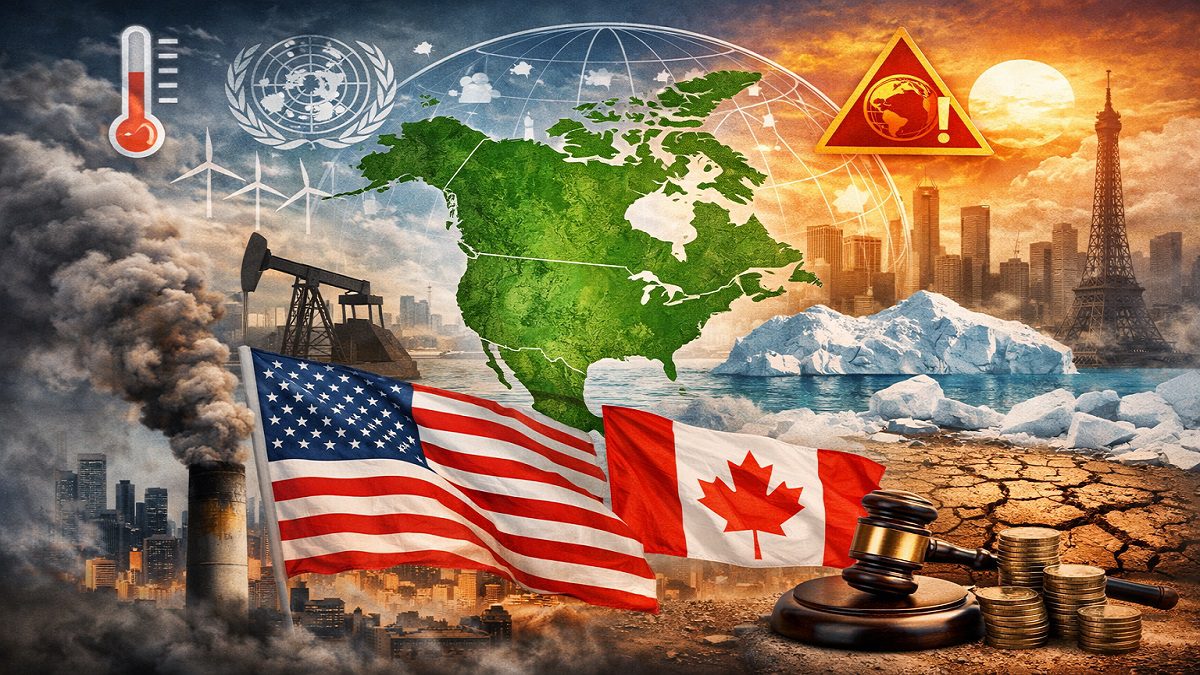
If developing nations get a free pass and Europe can meet its targets readily because of the arbitrary 1990 baseline, what is the point in adopting carbon emission caps that severely impact only the United States and Canada? It seems that North America has been consciously and deliberately singled out as the global villain of greenhouse gas emissions.
Why would the phalanx of the third-world nations, led by the UN and Western European nations, most of whom share social democratic values, attempt to force North America to pay such a steep price? Below are several reasons:
-
Socialist Dogma
Speculation leads to several possible answers, which are all plausible. When emissions targets were struck, the United States definitely had the dominant and most vibrant economy in the world. To outsiders, the United States was obviously more able to shoulder the financial burden of carbon cuts than most other nations. Ditto for Canada.
Socialist dogma is rooted in the belief that income redistribution is and should be a core function of government. In this instance, the UN imposed its values and objectives on its constituent parts. It is also frequently held that the wealth of rich nations comes at the expense of relatively less economically advantaged countries. Hence, “taxing” the industries of rich nations through carbon taxes and “Loss and Damage” funds seems perfectly fair and reasonable to advocates of wealth redistribution.
-
Global Governance
Keep in mind that the climate change agenda has been shepherded throughout by the United Nations, assisted in no small measure by institutions and individuals that subscribe to the ideals and merits of supranational agencies and organizations. Establishing world governing structures, institutions, and processes is their ultimate longer-term objective. Advocates of global governance commonly hold the view that nation-states are inherently self-serving and remain obstacles to attaining a higher level of civil and civic consciousness. Multinational organizations, measured against values like this, provide a superior form of government resulting in more desirable outcomes. How does the world reach this nirvana of global governance? The simple answer is by assembling it through a series of building blocks.
-
Need for Money
Think about it. The UN has existed since the end of World War II. Its constituent parts include agencies such as the International Court of Justice, World Bank, International Monetary Fund, World Health Organization, and many more. Its ubiquitous humanitarian aid and third-world development projects are universally known. These initiatives and responsibilities come at the expense of nation-states, which have ceded authority and money to the UN with its transnational reach.
Until now, many sovereign nations jockeyed to set their own foreign aid priorities, targets, and funding levels. It is also a fact that citizens in many first-world nations, especially the United States, are tiring of giving money to countries that have difficulty in using it efficiently and effectively. Too often, too much of it ends up in the pockets and Swiss bank accounts of government officials and other ‘kleptocrats’ in recipient nations. Is it any wonder there is increasing reluctance by national governments, the source of most development funding, to contribute to costly, corrupt, and questionable projects in failing and failed nations? Would not the range of programs sponsored by the UN be much more effective if the UN no longer needed to beg, compromise, or negotiate with sovereign nations for both mandates and funding?
-
Power and Influence
Referenced above is another emerging category of international institution called the Non-Governmental Organization (NGO). Because of their transnational origins, scope, structure, and technical specialties, over the years these groups have been enlisted by national governments and the UN as their preferred operational arms to implement their aid and development projects around the world. While many of their activities are project based, a continuing series of projects effectively necessitates large numbers of what amounts to permanent staff.
Employment, therefore, is frequently institutionalized, resulting in the full range of organizational imperatives. Large organizations mean large budgets, layers of management, and impressive staffing levels requiring many technical and professional skills. Job security and elevated pay grades assume greater importance. Power and influence are sought over policy and program priorities of both national governments and the international governmental agencies. In many ways, NGO and UN interests converge in that they both end up being advocates of supranational governance and institutions at the expense of individual countries.
Final Thoughts
The answer to the question of why the UN would attempt to force North America to adopt such stringent carbon emission caps? It is simply that the building blocks of international organizations depend on the exploitation of discrete needs and issues around and through which an organization can be established, grow, and institutionalize itself on its route to permanent status.
Clearly, climate warming provides a case study through which a single issue, global in scope, can be structured and managed to enlist the support of various constituencies. It becomes another multinational program initiated, managed, and promoted by the United Nations, which morphs into the placement of another permanent building block in the UN’s fledgling firmament. Organizations are built and processes created, which form a precedent for future initiatives coalescing around a different set of issues each time. This is the building block process employed to create and institutionalize global governance.
The issue of climate change has been enlisted to help construct global governing institutions. It was once said by political insiders that “it would be a shame to waste a good crisis.” What they meant was that a crisis can be mobilized to enlist the support of individuals, interest groups, and organizations that, under normal circumstances, would be impossible.
Global warming is not a crisis created by man wantonly burning fossil fuels to the detriment of nature. Rather, global warming is a methodically fabricated issue cleverly designed and exploited by proponents of global governance under the tutelage of the United Nations.