munKNEE.com Your Key to Making Money
As we navigate January 2026, we find ourselves at a crossroad. On the surface, the data looks promising: Artificial Intelligence (AI) is driving GDP growth at a healthy 2% to 3% rate.
Yet, for many, this feels like a “vibecession”, an economy that feels like it’s failing.
This AI growth masks a deepening crisis in the labor market. We are seeing “Low-Hire, Low-Fire” enviroment, where AI investments in infrastructure boost the bottom line, but entry-level hiring is collapsing. To understand why this is so dangerous, we have to look at the characteristics of the economy.
The Lesson of the “Lagging Indicator”
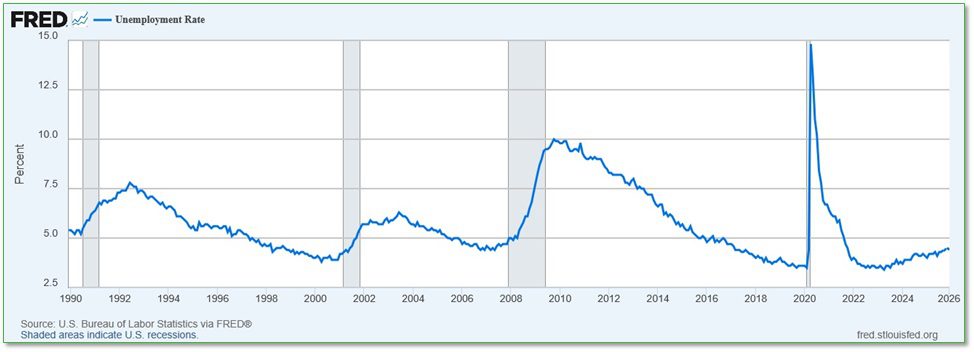
Employment is typically a lagging indicator; it is the last thing to recover after an economic crisis. We saw this clearly in the past:
The 1990-91 recession ended, but jobs didn’t follow for a year.
The 2001 recession ended in November, but job losses continued for another 1.5 years.
Looking back at 2010, the warning signs were already there. In 2010, the U.S. labor markets were failing, and the “recovery” was leaving millions behind.
By mid-2010, it became obvious that the long-term picture for families was worse than the headline loss of 7.5 million jobs. Many firms began “sharing the pain” by cutting hours and implementing furloughs.
If you were unemployed then, waiting for a simple “turn of the corner”, you had to hunker down. The traditional jobs were not coming back, and the structural damage was deeper than most realized.
The 2020 Pivot and the Rise of Silicon
We saw a radical departure from these slow-burning cycles during the 2020 pandemic. Instead of a slow bleed, the economy lost over 20 million jobs in a single month, the fastest and deepest collapse in history.
While the recovery was fueled by massive stimulus, it accelerated the automation trends. Today, in 2026, we are seeing the final result: an economy that grows through silicon rather than through a human workforce.
Stagflation Lite: The Roubini and Krugman Warnings
In 2026, this has evolved into what economists call “Stagflation Lite”. In his recent analysis, Nouriel Roubini argues that while the AI boom is “offsetting risks” to growth, we are simultaneously facing stagflationary pressures from tariffs and immigration restrictions.
He suggests that we are in a “growth recession”, where the economy technically expands, but potential growth is hampered by bad policy.
Similarly, Paul Krugman has warned that 2026 could be “worse for small businesses,” noting that while large corporations use AI to dodge rising costs, small firms are cutting jobs because they lack the scale to automate. According to data from payroll processor ADP, small businesses in the U.S. cut 120,000 jobs in November 2025.
During the global “White-Collar” outsourcing wave (1990s to 2010s), estimates that 25% of jobs were “outsourceable” have been proven right, but now with a twist: they weren’t just outsourced to other countries, they are now being “outsourced” to algorithms.
Structural Hurdles and the Risk of a “Jobless Growth” Era
In 2010, the average length of unemployment hit an all-time high. Today, while initial unemployment claims look stable, the “quits rate” is lower than pre-COVID levels, indicating that workers have no confidence in finding a new role.
If AI continues to displace complex office and creative work, we face a “jobless recovery” where GDP thrives, but the worker suffers.
This persistent weakness in labor income remains the Achilles heel of the recovery. When people don’t earn, they don’t spend. As a result, the risks are resurfacing in 2026:
- Real Estate: Commercial property is in a slow-motion crisis as remote work and AI-downsizing reduce the need for office space.
- Banking: Greater losses in credit cards and auto loans as consumer debt hits record highs.
- Protectionism: A return to aggressive tariffs as nations try to protect their remaining domestic industries from both foreign labor and AI.
The damage will be extensive and severe unless bold policy action is undertaken now. The crossroad of 2026 is clear: we can either use the productivity gains of AI to retrain the workforce, or we can allow a permanent divide to form between a growing GDP and a shrinking labor class.
FIGURE 1: U.S. Unemployment Rate