 munKNEE.com Your Key to Making Money
The U.S. dollar is the subject of great debate these days. Across financial markets, investors are debating whether it is good to have a strong dollar or a weak dollar policy.
Concerns focus on US fiscal deficits, monetary policy, and the growing total US government debt (Federal and State at $43+ trillion).
Instead of worrying about this issue, investors should try to deal with the reality of the situation and attempt to figure out the long-term direction of the dollar in order to come out ahead no matter what happens.
The Money Supply
In reality, despite the massive “printing press” frenzy in the wake of the COVID-19 pandemic tapering, the money supply in the economy remains a constant force in the economy. Currently, the federal government expenditures during the Trump presidency have continued to drive the national debt to exceed $40 trillion and budget deficits to surpass $2 trillion.
The government continues to flood the system with large amounts of liquidity via consistent borrowing. Washington continues to depend on the intervention of big government, characterized by deficit spending and financial buffers that prevent natural market adjustments and reward spending beyond one’s means.
This continual fiscal expansion adds more dollars to settle debts and fuel the growth of the economy, thereby creating ever greater imbalances. In the realm of Main Street, the fundamental principles of supply and demand continue to prevail. Given the consistent multi-trillion-dollar deficits by the U.S. government and the growth of the money supply to record levels, the large supply of dollars poses challenges to long-run currency demand. When the rising rate of US dollar “creation” outpaces the demand for the currency worldwide, it sets the stage for a US dollar decline.
The Stock Market
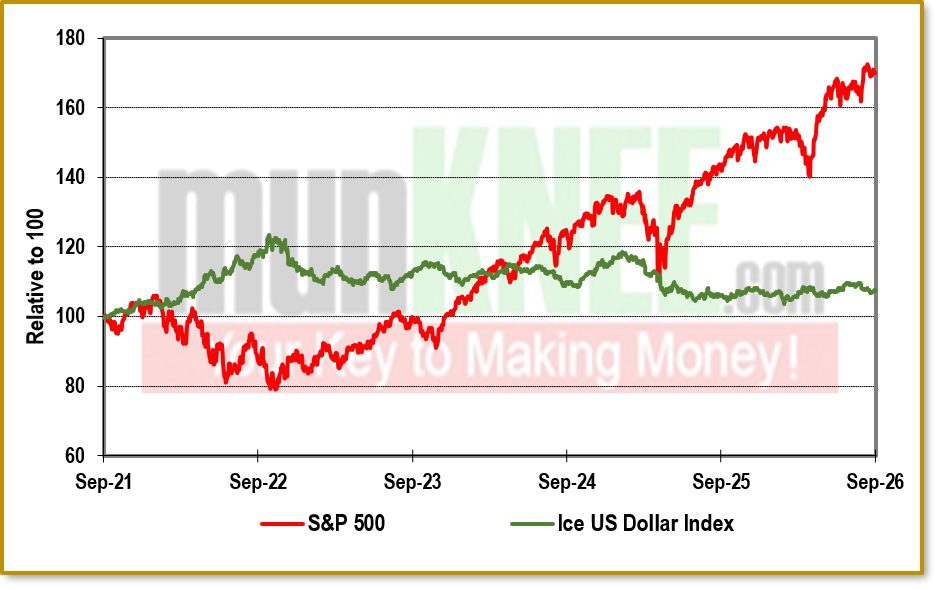
Financial theory often points to an inverse relationship between the U.S. dollar and large-cap stock performance, driven by the foreign-earnings translation benefits for multinational firms in the S&P 500 and DJIA.
But multi-year market cycles show that other drivers such as tech innovation, corporate earnings growth, and broader macroeconomic trends frequently override currency movements, allowing equities and the dollar to decouple entirely.
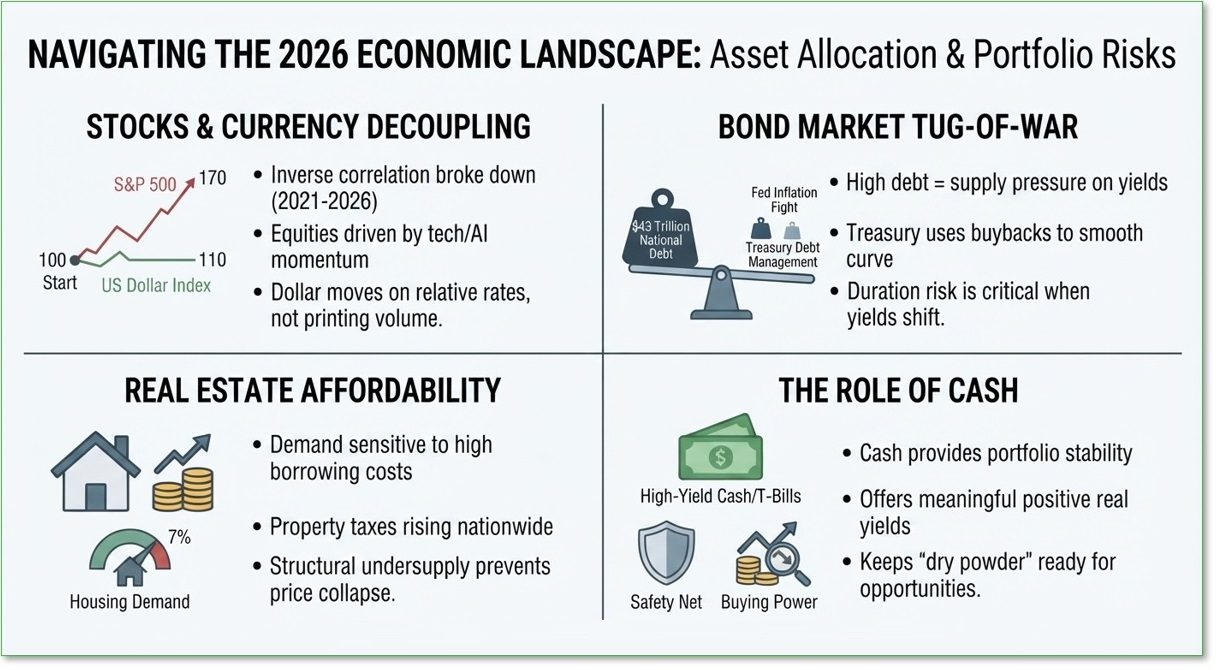
While there were periods (like mid-2022) where a rising dollar (green line) coincided with a dipping S&P 500 (red line), that inverse relationship has largely decoupled.
From late 2023 through 2026, the S&P 500 has risen sharply to around 170 on the index scale (based on 100 on September 2, 2021), driven heavily by tech growth and AI momentum.
Meanwhile, the ICE US Dollar Index flatlined and traded sideways in a tight band around the 105 to 110 range. They both went on very different trajectories rather than moving in reverse lockstep.
The Bond Market & Interest Rates
Imagine lending $100 to your friend with an agreement to get 3% of your money back some years later. If market rates go up to 6%, this loan would be of no value to other people since they could earn much more money on their savings. Hence, if you try to sell this contract before maturity, you would have to sell it at a discount and lose some of your money.
Currently, there is tension in the bond market due to the US government debt amounting to $40 trillion, with long-term yields facing upward pressure. At the same time, to absorb the growing volume of debt, investors seek better yields.
Meanwhile, the US Treasury Department is trying to deal with this situation discreetly and apply “intelligent” strategies (buying back long-term bonds) to influence the yield curve.
High interest rates do not mean an immediate death to all investment opportunities. But the Federal Reserve is trying to balance interest rates, inflation, and economic activity.
In general, the basic laws of the bond market remain the same: if the interest rates go up, the value of existing bonds with fixed coupon rates will drop if sold before the date of maturity.
To protect your savings, you have to understand how long your money is tied down (called “duration”).
Ask your financial advisor or broker a simple question about the bonds in your portfolio: “If long-term interest rates shift, how is that going to impact my investments?” If they look confused or brush it off, that’s your cue to find someone who can give you a straight, smart answer!
FIGURE 1: S&P 500 vs US Dollar Index
The Real Estate Market
Real estate is heavily sensitive to borrowing costs. When mortgage rates climb (as they did significantly from pandemic lows, stabilizing into the mid-6% range), monthly payments grow and this often leads to a housing demand decline.
But buyers with cash or investors focusing on rental yields, real estate often acts as an inflation hedge. For years, the U.S. housing market has suffered from a structural undersupply, which prevents housing prices from collapsing.
On the flip side, municipal property tax bills across the country have trended upward to cover rising inflation, infrastructure, labor, and public service costs. Climbing property taxes add to the overall cost of homeownership.
In short, the impact on the real estate market requires looking past broad doom-and-gloom storylines to focus on regional inventory, financing, and total cost of ownership.
The Money Market
Some pundits think sitting with cash in your portfolio is a bad idea because inflation can eat away at its purchasing power. And it’s true. If inflation is higher than the interest your cash earns, your real return is negative.
However, unlike the recent past when interest rates were near zero, today’s cash and short-term savings accounts offer real yields. More importantly, keeping some cash on hand gives you safety, stability, and the flexibility to buy investments when prices drop.
Foreign currencies might sound like a cool way to escape inflation, but high fees and complex exchange rates make them risky if you don’t know what you’re doing.
Final Thoughts
Handling the current complex economy, with increasing government debt, rising interest rates, and fluctuating currencies, requires a balanced approach.
It doesn’t matter if investors hold stocks, bonds, real estate, or cash in the mattress, it is essential for investors to learn about the basics of risk, such as duration and funding costs, and how they affect investment returns.
Thanks for reading! If you want more articles like the one above, register to receive our FREE newsletter. Or visit our Facebook page and follow us so you can get future articles automatically delivered to your feed. Or you can also “Follow the munKNEE” on Twitter.
Remember: munKNEE should be in everybody’s inbox and MONEY in everybody’s wallet!