 munKNEE.com Your Key to Making Money
In the contrarian spirit of playing devil’s advocate, six reasons why you shouldn’t buy gold today.
Reason 1: The ETF Liquidation Fragility
Did you know that one of the most volatile forces in the global bullion market isn’t a sovereign nation, but an exchange-traded fund? The SPDR Gold Shares ETF (GLD) remains an absolute behemoth, commanding over $140 billion in assets under management.
Buying sprees by emerging-market central banks, like China (whose official reserves have surged past 2,330 tonnes), mean GLD is no longer the largest gold owner. However, GLD still holds roughly 850 to 900 tonnes of physical bullion.
So why does this matter? Because GLD is held by institutional fast money: hedge funds, quantitative traders, and pension managers.
If a market shock forces these institutions to sell assets to cover margins or if retail investors pull out quickly, the fund is legally required to sell physical gold to meet redemptions.
This sudden, artificial avalanche of supply could put downward pressure on the spot price, leaving late-stage “gold bugs” exposed.
Reason 2: The Two-Timeframe Trap – Short-Term Oversold, Long-Term Overbought
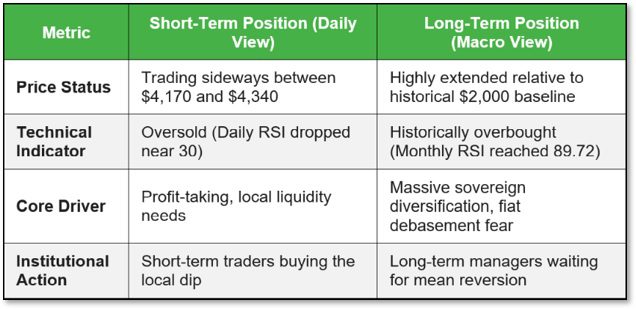
To understand the gold market today, you should separate the short-term oversold from the long-term overbought.
Recently, gold prices dropped quickly as investors took profits after technical indicators signaled overbought conditions. This sudden fall has tempted short-term traders to buy on the dips.
But investors should not confuse a temporary bounce with structural health. On a wider time horizon, some technical indicators suggest that gold remains historically overbought.
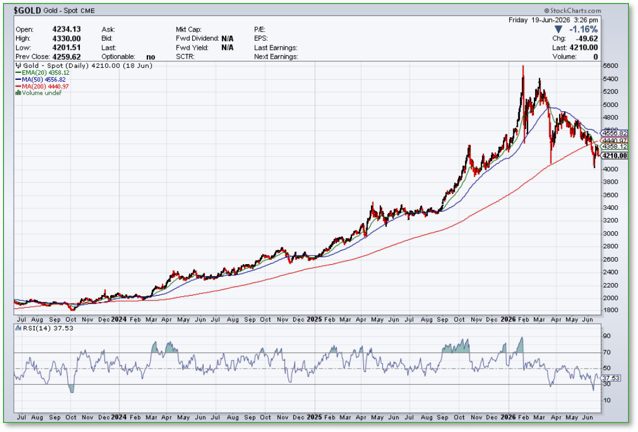
After a multi-year rally that carried spot gold well past $5,600 per ounce in January, the metal has entered an extended, choppy consolidation zone, stuck stubbornly below its 50-day moving average. When an asset climbs this quickly, its path of least resistance is sometimes a reversion to its mean.
A trigger for downward pressure on the gold price is the Federal Reserve’s commitment to controlling inflation. With inflation proving sticky and the labor market remaining resilient, interest rates could remain at current levels or even increase in the short term. This outlook keeps the opportunity cost of holding a non-yielding asset like gold relatively high.
When macroeconomic reality catches up with expectations, speculators could abandon ship just as fast as they boarded. This could leave late-stage buyers exposed to a much deeper market correction.
FIGURE 1: Gold Prices – Short-Term Position vs. Long-Term Position
Reason 3: Digital and Structural Alternatives Siphon Liquidity
In the past, gold served as the uncontested premier inflation hedge. But now gold does not have a monopoly as the sole refuge from fiat currency debasement. Today, capital that historically would have flooded into physical gold is being diverted.
The most prominent challenger is Bitcoin. The launch of spot Bitcoin ETFs means digital currency is now directly competing for the same investment dollars. Because Bitcoin has a strictly limited supply, many investors view it as “digital gold.”
At the same time, high interest rates mean short-term government bonds and cash accounts are paying guaranteed returns. With money split between Bitcoin, bonds, and other commodities, capital is no longer concentrated solely in gold. This drop in exclusive demand naturally limits how high gold prices can go.
Reason 4: Economic Resilience and Interest Rates
Much of the demand for gold comes from investors (because of worries about global debt and geopolitical tensions) and not from commercial or industrial applications.
This connection with macroeconomic uncertainty affects the asset’s performance. The U.S. Federal Reserve has kept the labor market stable and the benchmark interest rate between 3.50% and 3.75%. Despite inflation remaining above its long-term 2% target, the overall economy has been resilient.
This is a headwind for the metal. In the past, investors tended to flock to gold when there was a banking crisis or when interest rates dropped quickly. The incentive to keep a non-yielding asset such as gold is low as long as the economy doesn’t go into a severe recession and interest rates stay high.
Reason 5: The “Peak Buying” Trap of Central Bank De-Dollarization
The primary engine behind gold’s recent bull run has been continued buying by central banks, led heavily by the People’s Bank of China and Eastern European nations seeking to diversify away from US dollar-denominated reserves.
However, relying on this momentum carries risk. Recent data from the World Gold Council indicates that this sovereign buying spree is finally cooling off, with several major central banks pausing their net purchases.
Some countries, such as Türkiye, hit hardest by the energy shortages and economic problems from the U.S.-Iran war, are selling off portions of their gold to raise cash.
Retail investors buying gold today risk entering the market at a peak of institutional and sovereign demand.
Reason 6: Volatility and the Lost Yield Cost
Historically, gold was coveted as a defensive part of a balanced portfolio. Today, that thesis is being rewritten.
Gold’s trading profile has changed, with intraday swings of $100 to $150 becoming more common during periods of heightened market volatility. More importantly, holding a highly volatile asset that pays zero dividends or interest carries a cost.
When short-term government cash instruments guarantee a clean yield, parking capital in gold means foregoing the income available from interest-bearing alternatives whenever gold prices remain flat.
FIGURE 2: Gold Spot Price – From Overbought to Oversold? Trend Lines Converging, Waiting for the Next Directional Move
Thanks for reading! If you want more articles like the one above, register to receive our FREE newsletter. Or visit our Facebook page and follow us so you can get future articles automatically delivered to your feed. Or you can also “Follow the munKNEE” on Twitter.
Remember: munKNEE should be in everybody’s inbox and MONEY in everybody’s wallet!